The Adaptive Portal: How AI-Driven Personalization Is Turning Employee Platforms Into Strategic Assets
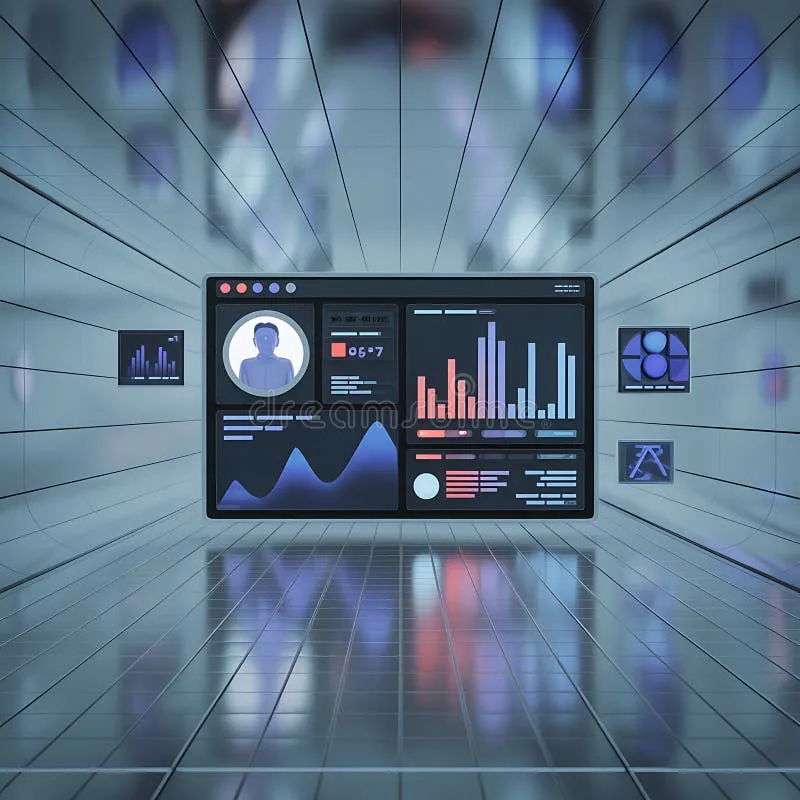
Photo: futuristic digital dashboard with personalized data analytics and employee engagement interface, via thumbs.dreamstime.com
For most of their existence, enterprise employee portals operated on a fundamentally egalitarian—and fundamentally flawed—assumption: that a single interface, organized around broad categories and universal navigation, could serve the needs of every employee in an organization. The result was a lowest-common-denominator experience that satisfied almost no one completely and left enormous value unrealized.
A warehouse associate in Memphis and a senior financial analyst in Chicago share an employer. They share very little else. Their daily tasks, the information they need to access, the training resources relevant to their roles, and the HR processes they interact with most frequently are almost entirely distinct. Yet for years, both employees were handed the same portal, the same homepage, and the same navigational logic—and expected to find their way.
AI-driven personalization engines are making that model obsolete.
What Personalization Actually Means in an Enterprise Context
The word "personalization" carries consumer-facing connotations—Netflix recommendations, targeted advertising, curated social media feeds. In the enterprise context, the concept is both more nuanced and higher-stakes. It is not about preference-matching for its own sake. It is about ensuring that every employee, at every moment of their workday, encounters a portal environment calibrated to their specific role, responsibilities, tenure, location, and behavioral patterns.
Modern personalization engines accomplish this through a combination of techniques: role-based content filtering, behavioral analytics that track how individual employees interact with the portal over time, natural language processing that interprets search intent, and machine learning models that refine their outputs continuously as new data accumulates.
The practical effect is an interface that learns. An employee who consistently accesses benefits information on Friday afternoons may find those resources surfaced more prominently by the platform. A manager who regularly reviews compliance training completion rates across their team will find that dashboard elevated in their default view. The portal does not wait to be asked—it anticipates.
From Information Repository to Intelligent Advisor
The most significant shift enabled by personalization technology is not aesthetic. It is functional. Traditional portals were, at their core, organized storage systems—places where information resided and employees retrieved it when needed. The burden of navigation, of knowing where to look and what to ask, rested entirely with the user.
Personalization engines invert this dynamic. Rather than passively housing information, an adaptive portal actively delivers it—pushing relevant content, flagging time-sensitive tasks, and contextualizing resources based on what the system understands about each employee's current circumstances.
Consider the onboarding experience. A new hire at a large organization might historically have encountered a portal with dozens of links, dozens of forms, and no clear sense of priority or sequence. An AI-personalized onboarding environment, by contrast, can present a dynamically generated checklist tailored to the employee's specific role and start date, surface introductory content from their immediate team, and progressively reveal additional resources as earlier tasks are completed. The experience is not just more pleasant—it is measurably more effective at accelerating time-to-productivity.
Implementation Strategies for Enterprise Environments
Organizations considering a move toward personalized portal experiences frequently encounter the same set of early questions: where to begin, how to structure the data infrastructure required, and how to balance personalization with privacy.
Start with role-based segmentation before pursuing individual-level personalization. The most immediately impactful implementations begin not with complex machine learning models, but with well-structured role and department taxonomies. Ensuring that a nurse in a hospital system sees clinically relevant resources while an administrator in the same organization sees operational ones requires clean data governance more than sophisticated AI. Building that foundation early makes subsequent individual-level personalization far more effective.
Invest in behavioral data collection with transparency. Personalization engines are only as capable as the data they are trained on. Organizations must establish mechanisms for capturing meaningful behavioral signals—search queries, content interactions, task completions, navigation paths—while being explicit with employees about what is collected and how it is used. Transparency is not only an ethical obligation; it is a practical one. Employees who trust their organization's data practices are more likely to engage with personalized features authentically.
Define ROI metrics before deployment. The business case for personalization investment is strongest when success criteria are established in advance. Relevant metrics include portal engagement rates, self-service task completion (which reduces HR help desk volume), time-to-competency for new hires, and learning module completion rates. Organizations that track these figures against pre-personalization baselines are consistently better positioned to demonstrate value and justify continued investment.
Competitive Advantage Beyond the Interface
Enterprises that have implemented mature personalization capabilities are discovering that the benefits extend well beyond individual employee experience. At the organizational level, personalization data generates a continuously updated picture of workforce behavior, skill gaps, and engagement patterns that leadership can act on strategically.
A personalization engine that tracks which training resources employees seek out voluntarily—versus which ones they complete only because they are required—provides HR leaders with nuanced intelligence about genuine skill development interest. That intelligence can inform talent development strategy, succession planning, and even hiring decisions in ways that static annual surveys cannot.
Several large US-based enterprises in the healthcare and financial services sectors have begun treating their portal personalization platforms as strategic intelligence assets, not merely employee experience tools. The data generated by millions of individual interactions is, in aggregate, a real-time organizational health indicator—one that updates continuously rather than once a year.
The Road Ahead
Personalization technology in the enterprise portal space is advancing rapidly, and the gap between organizations that invest in it deliberately and those that do not is widening. The next frontier involves deeper integration with workforce planning systems, enabling portals that not only respond to current employee needs but proactively surface development opportunities aligned with projected organizational requirements.
For enterprise leaders, the strategic imperative is clear: the employee portal is no longer a support function. In its most evolved form, it is a dynamic platform through which organizations develop, retain, and align their most important asset. The organizations that recognize this shift—and build the infrastructure to support it—will hold a meaningful advantage in the competition for both talent and performance.