The 2024 Workforce Skills Gap: Five Deficiencies Holding Organizations Back and How to Close Them
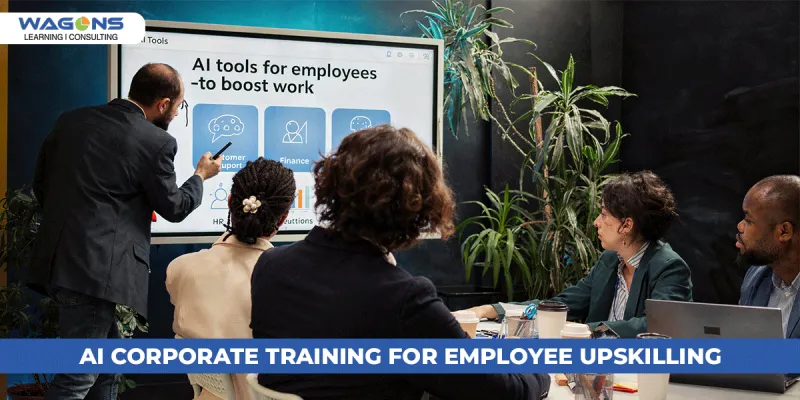
Photo: professional workforce training upskilling employees corporate development, via wagonslearning.com
The American workforce is undergoing one of its most consequential transitions in recent memory. Automation is reshaping job functions across industries. Remote and hybrid work models have permanently altered how teams collaborate. And the pace of technological change has outrun the capacity of traditional training programs to keep employees current.
The result is a skills gap that is no longer theoretical. According to the Society for Human Resource Management's 2024 State of the Workforce report, 75 percent of HR professionals in the United States report difficulty finding candidates with the right combination of technical and interpersonal competencies. Meanwhile, the World Economic Forum estimates that 44 percent of core job skills will be disrupted within the next five years.
For enterprise organizations, this is not a distant concern. It is an active operational challenge affecting productivity, retention, and competitive positioning right now. The following five skill deficiencies represent the most urgent gaps identified by employers across sectors—and for each, there are practical, scalable approaches that organizations can begin implementing immediately.
1. AI and Data Literacy
Artificial intelligence tools have moved from the periphery to the center of daily business operations with remarkable speed. Yet the majority of the current workforce has received little to no formal training in how to use, evaluate, or critically assess AI-generated outputs.
This gap manifests in two distinct ways. At the operational level, employees who lack AI fluency are slower to adopt productivity-enhancing tools, limiting the return on an organization's technology investments. At the strategic level, managers and directors who cannot interpret data or understand the limitations of AI-assisted analysis are vulnerable to making decisions based on flawed or misleading outputs.
How to close it: Organizations should begin by distinguishing between AI awareness—a broad understanding of what AI tools can and cannot do—and AI proficiency, which involves hands-on capability with specific platforms. Awareness training can be delivered at scale through structured e-learning modules and should be mandatory for all employees, not just technical staff. Proficiency development is best addressed through role-specific workshops that connect AI tools directly to the tasks employees perform daily. Vendors including Coursera for Business, LinkedIn Learning, and several university-affiliated programs now offer enterprise licensing for AI literacy curricula calibrated to non-technical audiences.
2. Complex Communication and Stakeholder Management
Remote and hybrid work arrangements have exposed a significant deficit in employees' ability to communicate effectively across hierarchies, functions, and digital channels. This is distinct from basic communication skills. It refers to the capacity to synthesize complex information for diverse audiences, manage competing stakeholder expectations, and navigate organizational dynamics without the benefit of in-person relationship cues.
A 2024 survey by the National Association of Colleges and Employers found that communication skills ranked as the top attribute sought by employers—yet fewer than half of hiring managers rated recent candidates as proficient in this area. The gap is not limited to entry-level employees; middle managers frequently struggle with upward communication and cross-departmental negotiation.
How to close it: Structured coaching programs, facilitated peer learning groups, and scenario-based training exercises are among the most effective interventions. Organizations with sufficient scale should consider embedding communication development into existing leadership pipelines rather than treating it as a standalone program. For smaller teams, external facilitators specializing in executive communication can deliver targeted workshops with measurable outcomes. Critically, organizations must create internal feedback mechanisms that allow employees to practice and refine these skills in low-stakes environments before applying them in high-visibility contexts.
3. Change Management and Organizational Adaptability
The frequency of organizational change—restructurings, technology transitions, regulatory shifts, market pivots—has accelerated to a degree that many employees find disorienting. The ability to navigate ambiguity, maintain productivity during transitions, and adapt workflows without losing momentum has become a foundational competency. Yet most employees have never received explicit instruction in how to do so.
Research from Prosci, a leading change management consultancy, consistently finds that projects with excellent change management practices are six times more likely to meet their objectives than those with poor or no change management. The capability gap here is not motivational—most employees want to adapt successfully. It is structural: they lack frameworks and tools for doing so.
How to close it: Change management competency can be built through a combination of formal certification programs—Prosci's ADKAR model is among the most widely adopted in US enterprises—and internal communities of practice where employees share experiences and strategies. Organizations should also examine whether their change communication practices are contributing to the gap. Employees who receive clear, consistent, and timely information during transitions adapt more successfully than those left to navigate uncertainty independently.
4. Financial and Business Acumen
Front-line employees and mid-level managers who lack a working understanding of how their decisions affect organizational financial performance represent a significant hidden liability. This does not mean every employee needs to read a balance sheet. It means that employees who understand the cost implications of their choices, the revenue drivers relevant to their function, and the basics of how their work connects to organizational outcomes make better decisions at every level.
A 2023 Gallup study found that employees who strongly agree they understand their organization's strategy and how their role contributes to it are 3.5 times more likely to be engaged at work—and engaged employees generate measurably better business outcomes.
How to close it: Business acumen training is most effective when it is contextualized rather than generic. Programs that use an organization's own financial data, product lines, and market context as teaching material are substantially more impactful than off-the-shelf finance courses. Many enterprise learning platforms now offer customizable business simulation tools that allow employees to make decisions and observe their financial consequences in a controlled environment. These tools are particularly effective for high-potential employees being developed for broader leadership roles.
5. Cross-Functional Collaboration and Systems Thinking
As organizational structures have become more matrixed and project-based, the ability to work effectively across departmental boundaries has become essential. Employees who can only operate within the context of their own function—who lack visibility into how adjacent teams work, what constraints they face, and how decisions ripple across the organization—create friction that slows execution and elevates conflict.
Systems thinking, the capacity to understand an organization as an interconnected whole rather than a collection of discrete parts, is the cognitive foundation for effective cross-functional work. It is also among the most difficult skills to develop, because it requires employees to deliberately expand their frame of reference beyond their immediate responsibilities.
How to close it: Cross-functional rotation programs, in which employees spend defined periods working within adjacent departments, are among the most effective tools for building this competency. For organizations where full rotations are impractical, structured cross-departmental project assignments and joint problem-solving sessions can achieve similar outcomes at lower operational cost. Enterprise portals and unified collaboration platforms also play an enabling role here: when employees have visibility into what other teams are working on, they develop a more integrated understanding of organizational operations organically.
Building a Skills Development Infrastructure That Scales
Addressing any one of these gaps in isolation is manageable. Addressing all five simultaneously—while maintaining operational continuity—requires a systematic approach to workforce development that is embedded in organizational strategy rather than treated as an HR initiative.
Organizations that close skills gaps most effectively share several characteristics: they conduct regular, data-driven skills assessments to track progress and identify emerging needs; they align learning and development investments with strategic priorities rather than defaulting to generic training catalogs; and they create environments in which continuous learning is normalized and rewarded rather than treated as a remediation activity.
The workforce of 2024 is capable of significant growth. The organizations that invest in creating the conditions for that growth will be the ones best positioned to compete in the years ahead.